Loading... ### Breakthrough in Multi-Core Fiber for Distributed AI Training by China Telecom and Huawei Recently, the China Telecom Research Institute, in collaboration with Guangdong Telecom and Huawei, has achieved a significant milestone in optical networking technology. Leveraging the "China Telecom Cloud-Network Fusion Technology Pilot Verification Platform" and an existing shared multi-core fiber transmission system, they successfully completed the industry's first on-site verification of distributed training across multiple intelligent computing centers using multi-core fiber. This was conducted at the China Telecom Guangzhou Southern Base Intelligent Computing Center, Guangzhou Shaxi Intelligent Computing Center, and Shenzhen Shahe Intelligent Computing Center. The interconnection spanned 409.61 km, with performance reaching over 97% of that achieved in centralized training setups. This verification breaks away from traditional reliance on single-mode fiber for interconnecting distributed intelligent computing centers. It marks the first time cross-city, large-scale intelligent computing interconnections have been validated in a multi-core fiber environment, demonstrating engineering feasibility and performance advantages. This paves the way for future high-bandwidth, scalable optical interconnection networks for intelligent computing. #### Key Technical Aspects of the Verification At the platform level, the effort relied on the world's longest multi-core fiber transmission system built under the "China Telecom Cloud-Network Fusion Technology Pilot Verification Platform." It employed single-wavelength 800 Gb/s ultra-high-speed optical transmission technology to enable stable, high-bandwidth, long-distance connectivity. The system fully utilizes the parallel transmission benefits of multi-core fiber in the spatial dimension. To address engineering challenges in existing multi-core fiber links—such as consistency in performance across cores and link attenuation—the team implemented refined optical power management and link performance optimization. This ensured high-quality intelligent computing optical interconnections for high-speed signals in complex cross-city environments, providing a critical physical-layer pathway for future ultra-high-bandwidth, ultra-high-density optical interconnections oriented toward intelligent computing centers. The platform has been included in the State-owned Assets Supervision and Administration Commission (SASAC) list of central enterprise pilot platforms. It offers over 20 publicly accessible pilot verification services, supporting on-site testing and engineering validation for next-generation optical network technologies. At the intelligent computing network level, the verification upgraded an end-to-end integrated "optical-network-computing-application" full-stack optimization scheme. This constructs a wide-area distributed intelligent computing center interconnection architecture with optical-electrical synergy, end-to-network synergy, and computing-network synergy. Through user-level congestion backpressure and precise control technologies for differentiated traffic, it delivers wide-area deterministic services for large-model intelligent computing operations. Here's a quick overview of the key metrics and innovations: | Aspect | Details | |--------|---------| | Interconnection Distance | 409.61 km | | Performance vs. Centralized Training | >97% | | Transmission Technology | Single-wave 800 Gb/s ultra-high-speed | | Fiber Type | Multi-core (leveraging spatial parallelism) | | Challenges Addressed | Core performance consistency, link attenuation via power management and optimization | | Platform Recognition | Included in SASAC central enterprise pilot list; >20 open services | For visual context on similar optical network architectures, here's a diagram illustrating low-latency metro networks and computing integrations, as seen in related Huawei technologies: 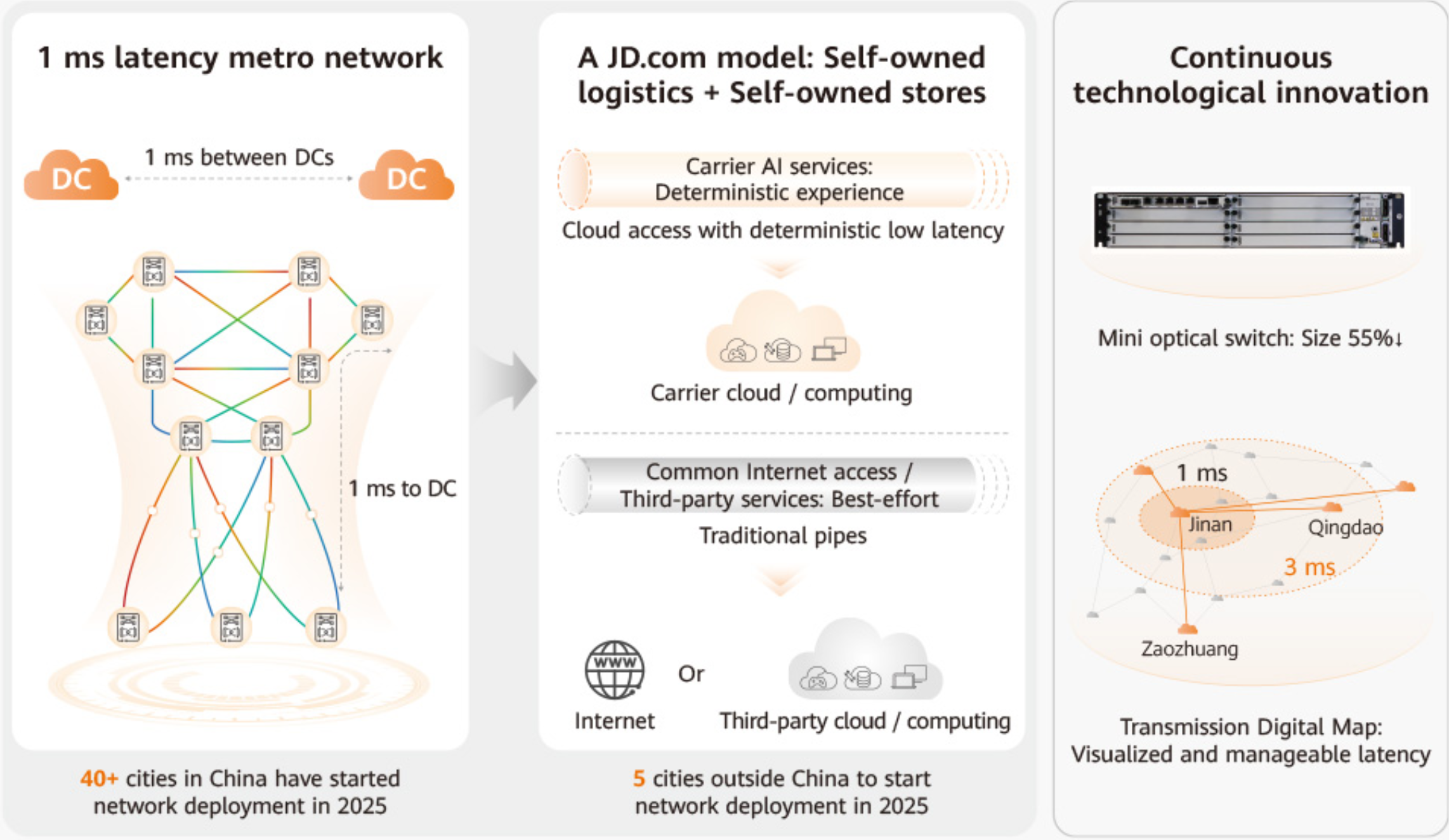 And another schematic showing all-optical Autonomous Driving Networks (ADN) for guaranteed reliable experiences in computing scenarios: 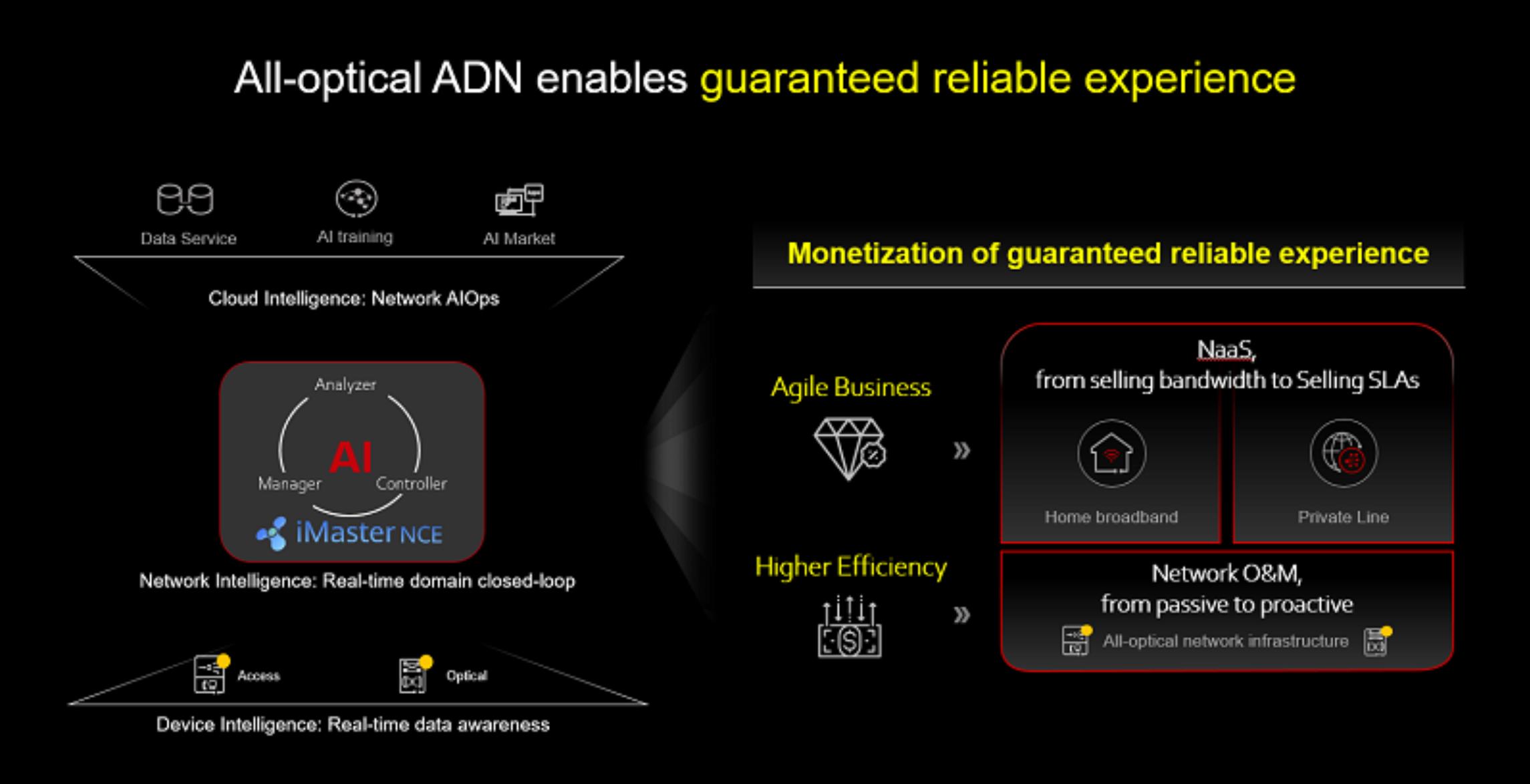 #### Future Outlook Looking ahead, as computing power demands continue to scale up and layouts evolve toward multi-regional dispersion, China Telecom plans to deepen its "cloud reform, digital transformation, and intelligent benefits" strategy. Aligned with the All-Optical Network 3.0 vision, the company will advance innovative research and large-scale deployment of key intelligent computing optical network technologies. This aims to build a new system characterized by high performance, strong resilience, and sustainable evolution, solidifying the foundation of computing power network infrastructure. Ultimately, it will provide robust optical network support for China's new digital infrastructure and the high-quality development of the artificial intelligence industry. 最后修改:2026 年 03 月 03 日 © 允许规范转载 赞 如果觉得我的文章对你有用,请随意赞赏